Media Exchange
Monitor
Cell Seeding
ImageXpress� HCS.ai
2
3
5
6
8

X, Y coordinate of automatic Matrigel dome placement across multiple plates and wells for multiple passaging cycles.

7


Monitor
3
2
4
1
5
6
7

Media Exchange

The CellXpress.ai Automated Cell Culture System transforms the cell seeding process through precision liquid handling and standardized protocols.
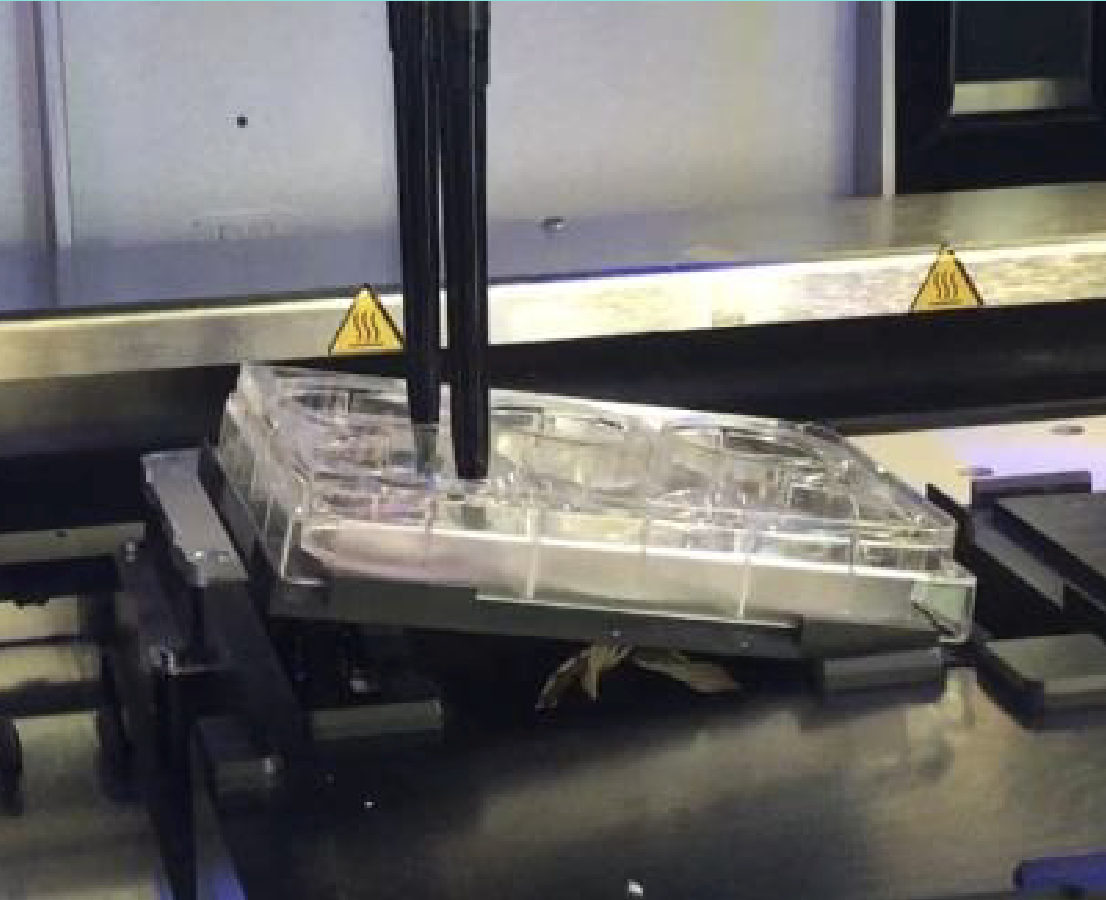
Automated cell handling: The system utilizes an 8-channel pipette head (Span 8) to precisely transfer cell suspensions with minimal variability.
Programmed mixing: Automated mixing ensures consistent cell suspension before and during the seeding process.
Precise dispensing: Controlled dispensing rates minimize cell stress while ensuring even distribution across culture vessels.
Protocol-driven process Turnkey, validated protocols guide the entire seeding process, eliminating variation between operators.
Environmental stability: Integrated environmental controls maintain optimal conditions during the sensitive seeding phase.
The CellXpress.ai system’s liquid handling capabilities eliminate the variability inherent in manual pipetting techniques, resulting in consistent seeding density across multiple vessels and experiments.

Passage

Automation ensures precision and consistency across multiple plates, reducing variability introduced by manual handling. Organoids are seeded into ultra-low attachment plates for initial aggregation. The CellXpress.ai system automates liquid handling, ensuring gentle transfers and minimizing errors — enabling researchers to scale up experiments with confidence, knowing each plate receives identical treatment.
�The system software lets users precisely set seeding parameters, select plate types, and automate feeding and imaging schedules. By standardizing these settings, the system ensures consistent cell seeding across multiple plates, minimizing human error and variability.
Cell Seeding

iPSCs are directed into neurons through the addition of specific growth factors in the culture media and begin neural structural organization. The CellXpress.ai system streamlines media exchanges and integrates imaging for real-time monitoring, verifying reproducibility and differentiation.
�These visuals demonstrate the reproducibility and effectiveness of workflows performed on the CellXpress.ai system. By monitoring organoid development at each stage, researchers can ensure consistent differentiation and identify any deviations early, improving experimental outcomes.
Neural Induction and Organoid Formation

Organoids are transitioned to larger culture wells and transfer success can be verified by the system’s integrated imager. The CellXpress.ai system ensures gentle, automated transfers and optimized media handling, reducing variability and contamination risk.
�
Transfer of Organoids
Cell plating
Cell plating can be automated on a liquid handler. This may involve seeding a cell suspension for 2D cultures or handling organoids mixed in Matrigel.
Cells are maintained in an incubator, and media changes can be scheduled and carried out on the
liquid handling deck.
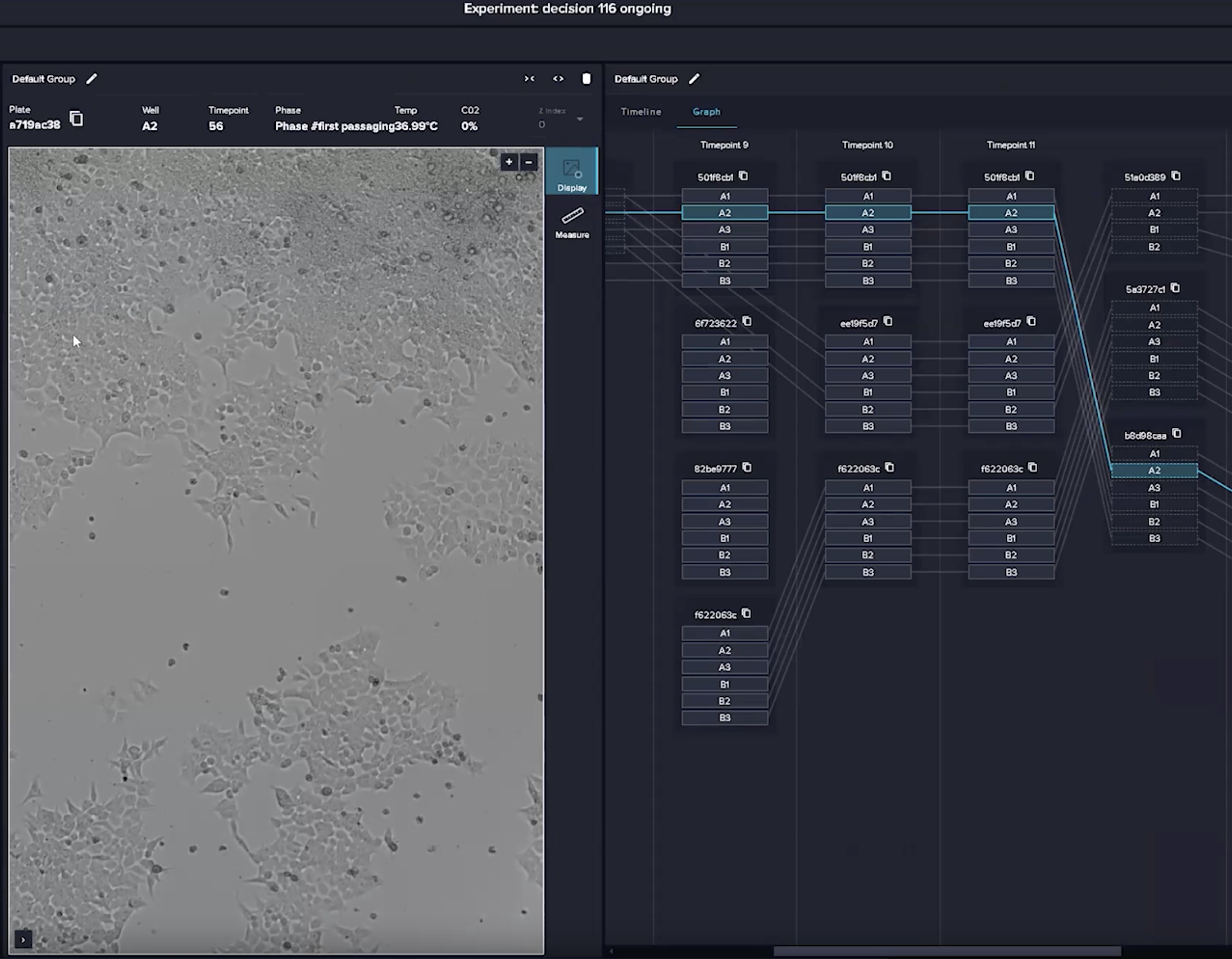
Cells are monitored with an imager. This is followed by on-the-fly, AI-enabled image analysis, which can be configured to trigger downstream steps based on
the results.
iPSCs are
seeded into low attachment 96
well plates.
Cells are transferred into low attachment 24-well plates for neural induction
Organoids are transferred to 6-well plates using wide-bore pipette tips
Organoids undergo long-term culture, continuing
to differentiate into multiple neuronal and
glial cell types.
1
Cell Plating
1
2
3
4
6
7


Learn more
CellXpress.ai Automated
Cell Culture System
Give your lab the confidence in experimental outcomes to make key decisions sooner and achieve milestones faster with fewer failed experiments.
Built by scientists, for scientists, the CellXpress.ai system features AI-driven decision-making and biologist-friendly protocols that automate 2D and 3D model cell culture processes to eliminate manual intervention, streamline workflows, and reduce hands-on time in
the lab.


Deeper insights for every lab
The ImageXpress HCS.ai system is built with a modular architecture that grows with your research. Whether you're starting with widefield imaging or advancing into confocal and deep tissue analysis, this system evolves with your needs—no full system replacement required. A broad range of configuration options and intuitive acquisition software with AI and machine-learning capabilities make it easy to upgrade, adapt, and scale—future-proofing your investment and accelerating discovery.
ImageXpress.HCS.ai

Catch every spike. Accelerate every insight.
Delivers fast, sensitive kinetic data acquisition for ion channels, GPCRs, and intracellular signaling, with scalable throughput and flexible assay formats—empowering you to accelerate drug discovery using physiologically relevant models like iPSC-derived cardiomyocytes and neurons.
FLIPR Penta Screening System


1
Cell plating in
hydrogel domes
Media exchange
2
Monitoring
3
Disruption of domes
and organoids
4
Centrifugation�
5
6
Mix cells with
hydrogel, re-plate�
7
Confocal imaging,�image analysis
FLIPR Penta High-Throughput Cellular Screening System
CellXpress.ai Automated
Cell Culture System
9
Mature organoids are treated with test compounds for efficacy or safety studies.

Passage
Passaging is often carried out when iPSCs are confluent. In this case, a decision-making protocol can be set up to trigger the passaging step.
4

Neural Induction and Organoid Formation
Transfer of Organoids
Differentiation &�Maturation
Compound Treatment & Functional Characterization


CellXpress.ai Automated
Cell Culture System


Brain Organoid Workflow
IPSC Workflow

Imaging and AI analysis track structural organization and viability, a process that typically requires more than 100 days for complete maturation. Here, the rocking incubator provides continuous gentle motion—delivering nutrients and oxygen evenly while preventing aggregation and necrosis in long-term organoid workflows.
Manual maintenance of just 10 brain organoid plates—including daily feeding and imaging—requires nearly 27 hours of hands-on time each week. With the CellXpress.ai system, that workload is reduced to just a few hours, freeing researchers to focus on discovery rather than routine maintenance.*
*estimate based on daily feeding and imaging of brain organoids cultured in ten 96-well plates.
Differentiation and Maturation
8

The CellXpress.ai system schedules compound additions, standardizes incubation and washes, and captures morphological and viability endpoints with integrated imaging.
For functional readouts, you can record calcium oscillation activity and compare control vs. treated responses on the FLIPR Penta system where high-throughput network activity assays link structure to performance for robust dose–response and time‑course insights.
Compound Treatment & Functional Characterization
Click to
learn more


8
9
5
9
The CellXpress.ai system delivers consistent maintenance through scheduled interventions and precise environmental control.
Automated media exchanges: The system performs media changes according to programmed schedules without human intervention.
Media temperature management: Dedicated heating and cooling positions ensure media is at optimal temperature before introduction to cells.
Environmental regulation: Integrated CO₂, temperature, and humidity control maintain stable conditions throughout the culture period.
Contamination prevention: Automated hydrogen peroxide decontamination and on-deck UV decontamination features maintain sterility.
Smart media handling: Software-controlled heating, cooling, stirring, and volume tracking support various workflow environments with different media vessel types.
This comprehensive approach to maintenance eliminates the variability and potential for human error associated with manual culture techniques, while the automated decontamination features significantly reduce contamination risks.
Learn more
Learn more
The CellXpress.ai system revolutionizes culture monitoring through advanced imaging capabilities and AI-powered analysis.
Integrated imaging system: The platform features a 24-megapixel camera system with objectives ranging from 2X to 40X for detailed cell visualization.
Multiple imaging modalities: Supports time-lapse, Z-stack, and optional Digital Confocal imaging across multiple channels (up to 6 fluorescence channels).
Automated imaging schedule: Performs regular imaging according to programmed intervals without user intervention.
AI-powered image analysis: Machine learning algorithms analyze cellular morphology, confluence, and health status in real-time.
Data-driven decisions: AI-based classification and segmentation enable automated decision-making regarding maintenance and passaging needs.
This integrated monitoring approach provides comprehensive documentation of the entire cell culture process while enabling real-time assessment of culture status without human subjectivity.
Learn more
The CellXpress.ai system transforms cell passaging from a manual, time-sensitive task into a standardized, automated process.
AI-guided timing: Machine learning algorithms analyze cell density and morphology to determine optimal passaging timing.
Automated protocol execution: The system handles the complete passaging workflow, from media removal to cell detachment and collection.
Standardized parameters: Consistent application of dissociation agents and incubation times eliminates process variability.
Cell counting and viability assessment: Integrated analysis determines cell concentration and viability for appropriate reseeding.
Controlled reseeding: Precise dispensing ensures consistent seeding density in new vessels.
By automating the passaging process, the system eliminates the subjectivity of determining when to passage and standardizes the procedure across all samples and experiments.
Learn more


Cell Plating
Compound Treatment
& Functional Characterization
Differentiation
& Maturation
Transfer of Organoids
Neural Induction and Organoid Formation
Cell Seeding
Passage
Monitor
Media Exchange

Click to
learn more
Click to
learn more



Learn more
Learn more
Learn more
Learn more
Learn more
Learn more
Learn more

Passage
Monitor
Media Exchange
Cell Plating
Six brightfield images of organoids at different formation stages and a schematic illustrating progression from a simple spheroid to a complex organoid structure.
This visual emphasizes positional tracking and imaging consistency during organoid transfer. Plate view with multiple organoids distributed across wells. On the left, smaller preview panels display different wells, while the main panel on the right shows a single plate grid.
The CellXpress.ai system's rocking incubator